Are You Talking to the Right Elephant?
I know that feeling. You're talking about something you care deeply about - something you've built, something that matters - and you can feel the other person closing off. Their eyes shift. Their shoulders soften in a way that isn't quite listening anymore. Your story never connected with their heart. And the more you talk, the more they retreat. Tony from Daylight.ie knews that feeling too.
Tony's product - the E'Window - uses LED Sky Panel technology to mimic natural daylight from sunrise to sunset, delivering its health benefits to any enclosed or windowless space.
Tony has done his research: drawing on Professor Russell Foster at Oxford on sleep and circadian rhythm, Professor Glen Jeffreys at UCL on the importance of morning daylight, and stories about daylight for every industry that could benefit from it. When he came to me, his challenge was getting his message across. He has an excellent product, real expertise, solid science - but his pitch wasn't landing.
Looking at his work together, the problem became clear. Tony, like most of us, assumed that if you give people enough good information, they'll make the right decision.
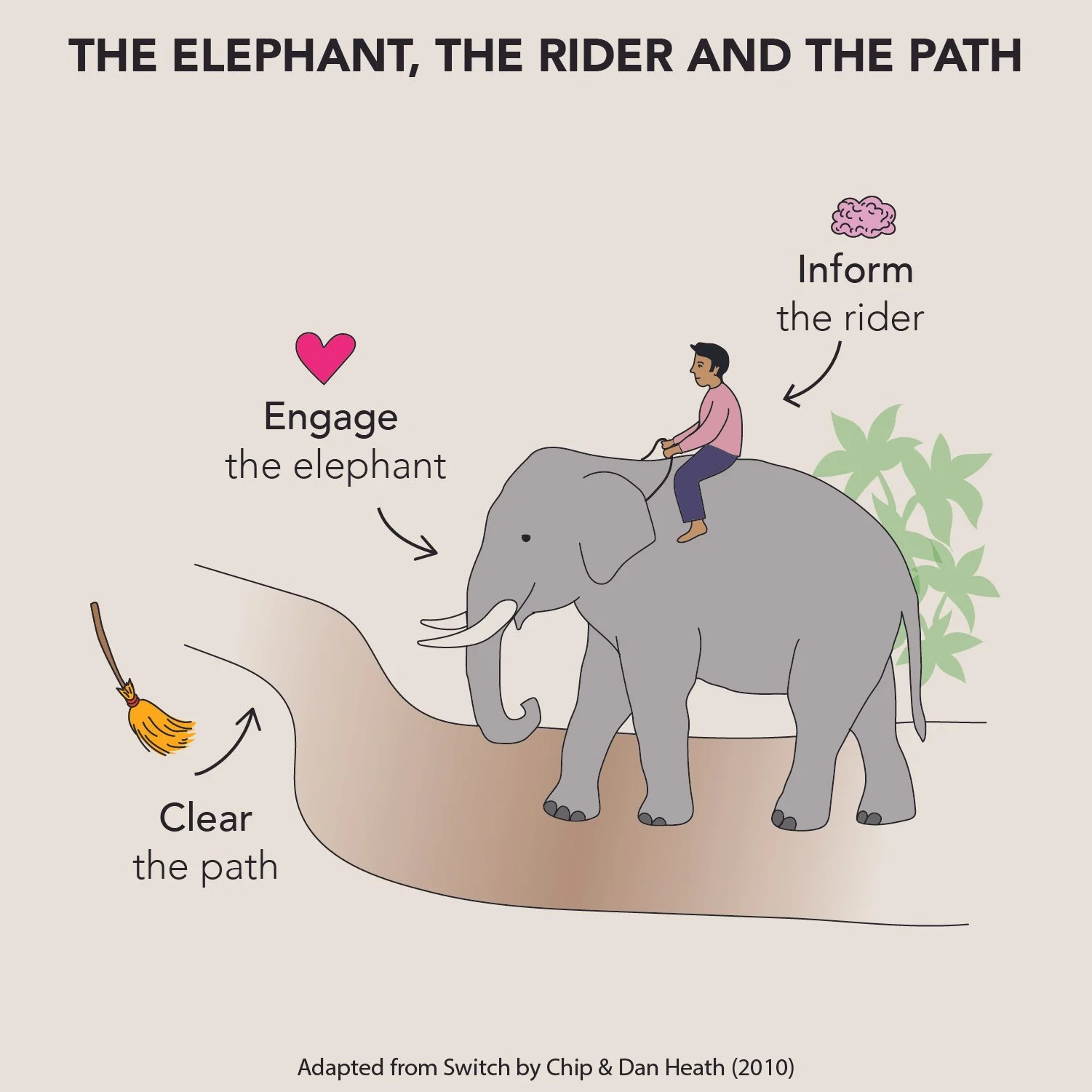
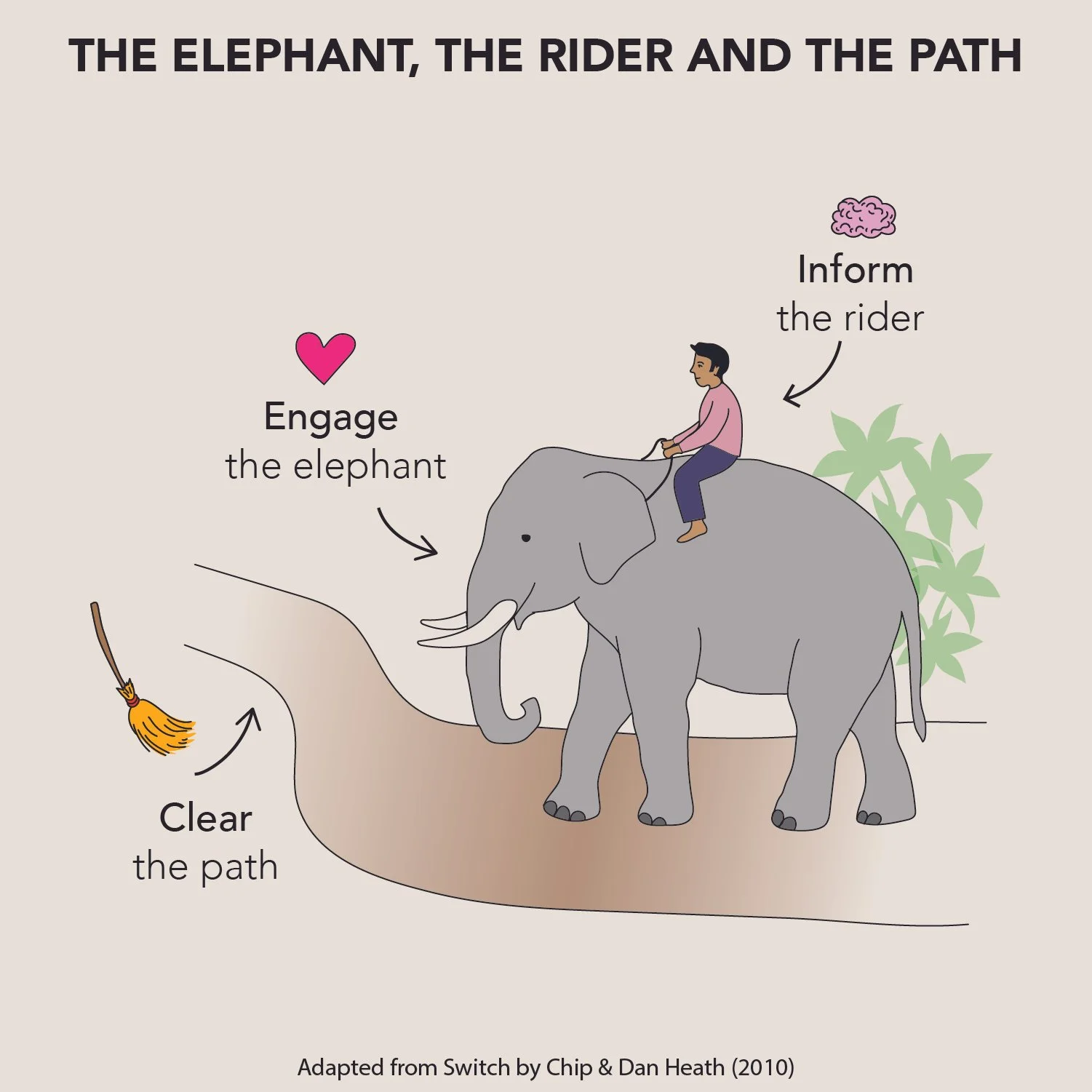
This challenge calls for the Elephant, the Rider, and the Path - a model popularised by Chip and Dan Heath's book: Switch. I've used it with clients again and again for over a decade. It shifts how people understand their own communication. And once they see it, they can't unsee it.
The Elephant, the Rider, and the Path
Jonathan Haidt described it first: we're not one unified self. We're a rider on an elephant. The Rider is the rational mind - it wants facts, proof, logic. The Elephant is the heart - it needs to feel that something matters, to have a reason to move. Most of us, when we're passionate, flood the Rider with information and hope the Elephant follows. It doesn't work that way.
Chip and Dan Heath built on Haidt's idea in their book Switch, adding a third element: the Path. Even when the Elephant is moved, and the Rider is convinced, if the next step is unclear or feels too hard, nothing happens. The door stays closed.
And, it’s important to also remember, every Elephant is different, and every Elephant already has a direction it's heading. Trying to redirect one that's committed elsewhere takes enormous energy - and usually fails. The smarter question is: whose Elephant is already moving in the direction I'm heading?
Back to Tony. He identified care homes and hospitals as sectors that would most benefit from his product, with two key entry points: the Director of Nursing and the facility manager. Two completely different Elephants. The Director of Nursing's Elephant moves toward healing and patient wellbeing - research shows that patients in daylight-filled rooms recover faster and go home sooner. The facility manager's Elephant is heading toward cost control and efficiency - shorter patient stays mean lower costs. Same product. Two different stories. Two different conversations.
In Tony's own words:
““Before our session, I thought if I gave people enough information, they’d understand how good this is. Now I see I was flooding the room. Naomi’s visuals made it click: I need to find the person whose elephant is already moving in the right direction, and tell them the story that speaks to their heart first. Once they’re engaged, I can share the information that will help them make an informed decision.” ”
Engage the Elephant, inform the Rider, clear the Path.
So before your next meeting, pitch or working on any communication material, ask yourself:
How can I engage the Elephant? This means starting with what they care about and what motivates them - not what you care about. Ask, what does your audience care about? Can you connect your story to what they already value? Do your passion and motivation align?
How can I inform the Rider? Direct the rider using relevant information. Ask: What information would support your audience’s motivation? Is the information short enough to actually land? Are the key facts there without drowning everything else? Edit ruthlessly - keep only what serves the outcome you're trying to achieve.
How can I clear the Path? Ensure you shape the path to the results you want. Ask: Is the next step obvious? Have you removed the blocks and made yes easier than no? If saying yes still requires effort or guesswork, most people won't take it.
Why is this hard to do alone?
Once you know something deeply, it becomes almost impossible to see it the way someone encountering it for the first time would. Chip and Dan Heath call it "the curse of knowledge." That's not a personal failing - it's the nature of expertise.
If what you've read here resonated, and you notice a touch of that curse, feel free to reach out - we can explore a better way forward together.
Book your free conversation at thinkvisual.ie/letschat or call me on 086 3743132.
And if you're curious about Tony's E’Window, reach him at tony@daylight.ie.