Finding Confidence Off the Beaten Track
Exploring what’s behind losing confidence — and how we might reframe it
To write this post, I wanted to see what I was doing nine years ago, a year before my daughter was born. I wanted to meet the confident Naomi of March 2017.
Back then, my days were full. I had five employees, a dozen contractors, meetings, projects, deadlines. My calendar was the map of an up-and-coming business life.
So I opened my calendar and started clicking the arrow backwards. 2026, 2025, 2024…
But when I reached 2017, the calendar was empty.
Completely empty.
After a bit of digging, I realised that, for some strange reason, everything from before my daughter was born in March 2018 had disappeared.
Gone.
The only things left are the recurring Monday morning team meetings. They sit there like tombstones of my old life.
And I can’t help thinking it’s a perfect metaphor. Naomi of 2017 is gone.
When my daughter was born, that chapter ended. It went up in pixelated flames, and something else began.
Even now, I sometimes struggle to remember who I was then. That’s when I turn to people who know me — to remind me that all my experience is still here, waiting to be used.
For many years after her birth, I moved through different stages of grief: first fighting to hold on to my old identity, then — as tiredness and brain fog forced me to face reality — grieving, and eventually accepting that Naomi of 2017 is truly gone.
But, like in a garden, nothing is ever truly lost. My old identity was composted, becoming the ground on which I am rebuilding myself.
For me, this shift came through motherhood. For others, it might come through illness, redundancy, or a slower awakening — the kind that reaches a point where your body simply won’t let you continue as before.
And when you go through a change like this, your confidence is often one of the first things to go.
A week thinking about confidence
As my daughter’s eighth birthday approaches, I’ve been thinking a lot about confidence.
Or more precisely, the lack of it.
Not just my own, but the quiet uncertainty I often hear when speaking with people building businesses or practices — especially those trying to create something meaningful, not just profitable.
Three business owners I’ve come across through the Her Circle community come to mind.
Antje Guest, who runs the Samara Centre for Arts and Wellbeing in Clonakilty, keeps her room pricing intentionally affordable. She recognises that for arts practitioners, especially women, access to space can be a lifeline — supporting the gentle balance between parenting, generating a livelihoods while contributing to the wellbeing of the wider community.
Rita Higgins, a Kinsale-based food systems consultant and landscape designer, is developing a more accessible offer for garden owners who share her commitment to caring for the natural environment. She’s currently planning a monthly landscape salon — a space for people to come together, share knowledge and resources, and explore how their gardens can support biodiversity, even without full design support.
Melanie Downes, of Horse Knowing — Equine Assisted Learning in Westmeath, facilitates interactions between humans and horses to support personal growth, life skills, and emotional healing. She’s exploring ways to make her work accessible to young people and Adults from disadvantaged backgrounds who may not have the capacity to engage with traditional, talk-based approaches.
Each of these businesses, in their own way, is balancing sustainability with accessibility — finding ways to make their work both viable and meaningful.
My own business, Think Visual, which has taken different forms over the years, is similar. While it may have looked like I was walking a mainstream business path, in reality, I was straying far from it.
From my accountant’s perspective, I was doing it all wrong.
And when doubt creeps in, I can still hear her voice questioning decisions guided more by values than by conventional logic.
But when I meet that self-doubt, I remind myself: when you build a business guided by values, you step off the beaten track — into a place where old maps and expert advice don’t always apply.
And in that kind of landscape, wobbly confidence is to be expected.
What is confidence, really?
We often think of confidence as something internal — a personality trait that some people have, and others don’t.
But certain models offer a different perspective, helping us reframe the story we tell ourselves.
One of these is the Authority, Presence, Impact Model (API), developed by Peter Hawkins and Nick Smith. It describes confidence through three interconnected elements:
Authority — What do I truly know? What qualifications, experience, or lived knowledge support my work?
Presence — Can I stay grounded and connected to myself and others in the moment?
Impact — What evidence can I gather about the difference my work is making?
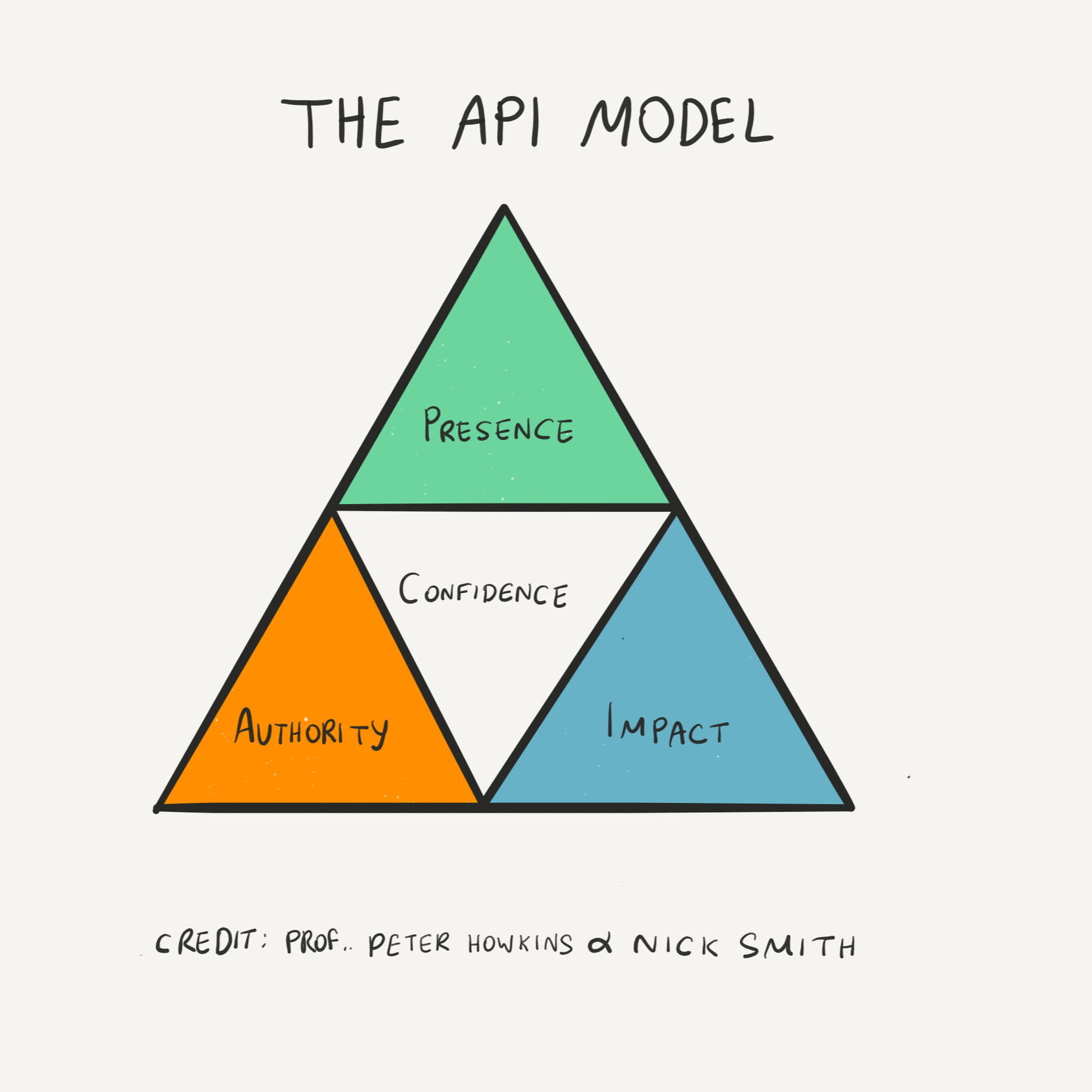
Seen this way, confidence is not something we either have or don’t have. It grows through experience, reflection, and recognising the impact of our work.
This model can soften the guilt or shame that often comes with feeling “not confident enough,” and instead create space for curiosity.
You might discover that you are more confident than you thought — or that there are clear, practical ways to strengthen the areas that feel less steady.
Innovators rarely feel confident
Another perspective that helps me make sense of this comes from the Berkana Two Loops Model.
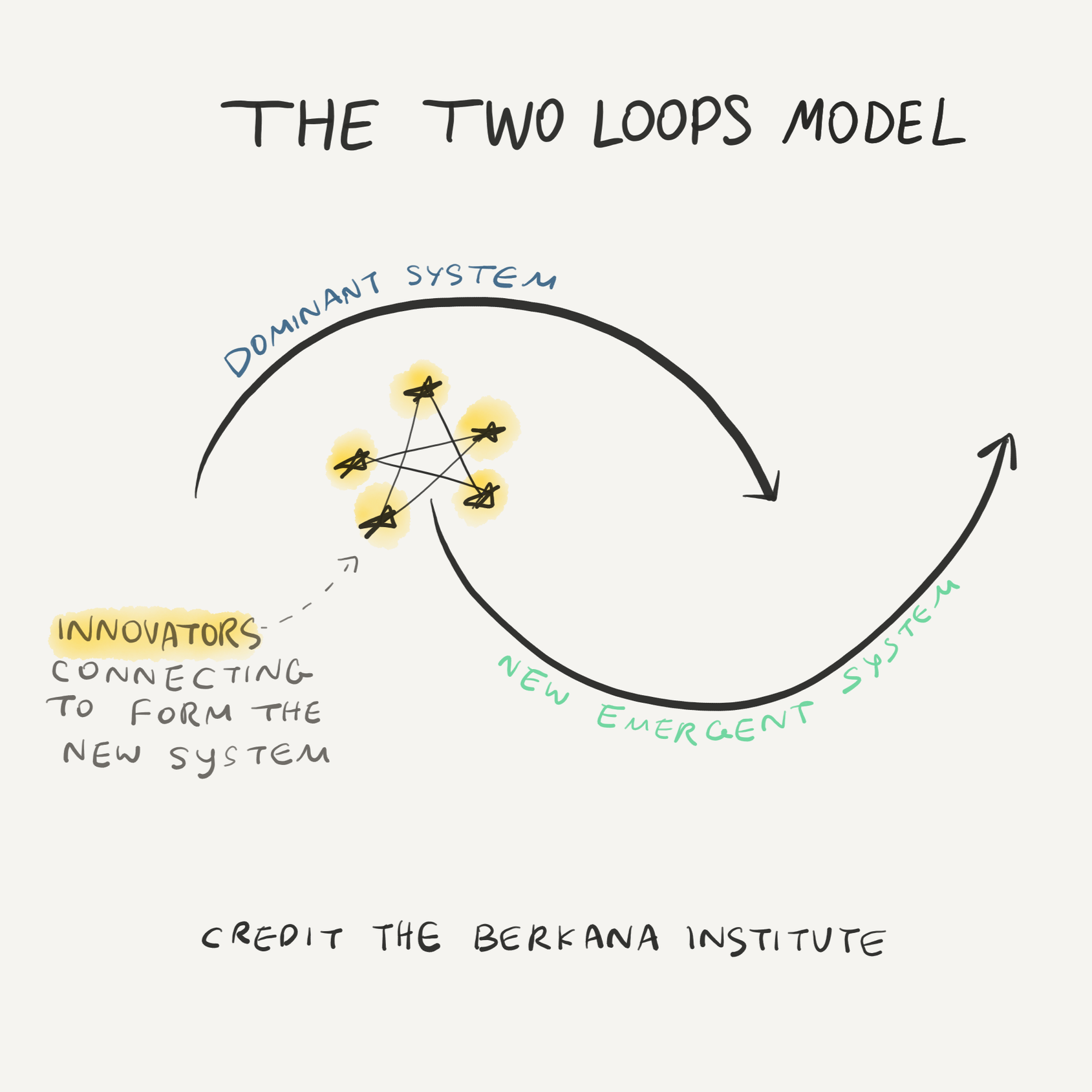
This model describes how systems change.
The dominant system continues for a long time, but gradually begins to decline. At the same time, small groups of people start experimenting with new ways of working.
At first, these innovators are scattered. Their work doesn’t fit neatly into existing categories. They often feel uncertain.
While they are bravely attempting to create something new, they rarely appear confident from the outside.
They are testing ideas, navigating the unknown, often working in response to gaps the existing system is no longer meeting. For a long time, this can feel like stumbling in the dark — with little recognition, and sometimes a strong temptation to give up.
But when they begin to find each other — when connections form, ideas spread, and new narratives emerge — something shifts.
New ways of working start to take root.
When I look at many of the business owners I meet, like Antje, Rita and Melanie — people building thoughtful, community-centred, purpose-driven work — I sometimes wonder if we are witnessing the early stages of that new loop.
But when you’re inside a shift like this, it rarely feels like innovation.
More often, it feels like doubt.
A few questions about confidence
So perhaps the question isn’t simply:
Why don’t I feel confident?
Maybe more useful questions are:
Where does my authority come from in this work?
How can I stay present when the path feels uncertain?
How can I notice and gather evidence of the impact I’m having?
Am I, in some way, an innovator — trying new ways of doing things?
And if so, who else might be walking a similar path?
What can I learn from others’ successes and failures?
We build both new systems and our own confidence through conversation, reflection, and seeing our work through fresh eyes.
An invitation
If you’re building something that matters to you, and things feel unclear or stuck, it can help to step back and look at the bigger picture with someone else.
That’s what a discovery call is for.
A simple conversation to explore whether working together might be helpful — and whether my approach resonates with the way you want to work.
If that feels useful, you’re very welcome to book a time here:
www.thinkvisual.ie/letschat