
Tending the Garden: A Community Developer's Approach to Marketing
Many of my clients tell me they have been showing up consistently - posting regularly, trying different platforms, doing the things you are supposed to do. But it costs more than it gives back. The time it takes. Two hours disappear between deciding to post and actually posting. "I feel like I am shouting into a room where nobody is listening," someone said to me recently. "And I am exhausted."
What strikes me is not the exhaustion. That makes sense. It is the assumption underneath it - more platforms, more posts, more visibility is always the answer. We have inherited this belief. And I think it is time to question where it came from.
When I look at the roots of "more is better," I keep arriving at the same place: the Industrial Revolution. The shift from handmade, agricultural societies to automated industrial ones brought a big promise: we could produce more for less time. And with that came a whole belief system. More output equals more value. More money brings more power. And power - finally - feels like the path to the thing we are all actually craving underneath: safety. If I can control enough - my income, my visibility, my reputation - I will finally feel secure. I can stop bracing.
Except control doesn't deliver that. It can't. Because life is not controllable, and the more we try to hold it, the more energy it takes. So the safety never arrives. "More" is a horizon. You move toward it and it keeps moving. We end up time-poor, money-poor, energy-poor - not because we actually are, but because our eyes are permanently fixed somewhere ahead.
This belief runs straight through how most of us think about marketing. If you are not on Instagram AND Facebook AND LinkedIn AND everything else, you are missing your audience. Post every day, or the algorithm will forget you. Even people who are genuinely consistent carry an inner voice the outer pressure has installed: this is not enough. You need to do more.
What if that voice belongs to a map that no longer fits the territory?
If your identity and business are rooted in CARE, not MORE - if you wish to mind our planet, our people, and have a viable business - then the old marketing rulebook may not just be exhausting. It may be the wrong map entirely.
So what does the right map look like?
I came to this through an unusual back door. I started in community development - working with migrants, youth, women - before moving into design and business consulting. For the past decade I have been finding a visual way to map human ecosystems: businesses, teams, organisations. Seeing the whole picture in one view unlocks something unexpected. Time and again, my clients find clarity they couldn't access through Excel sheets and text-heavy marketing strategies.
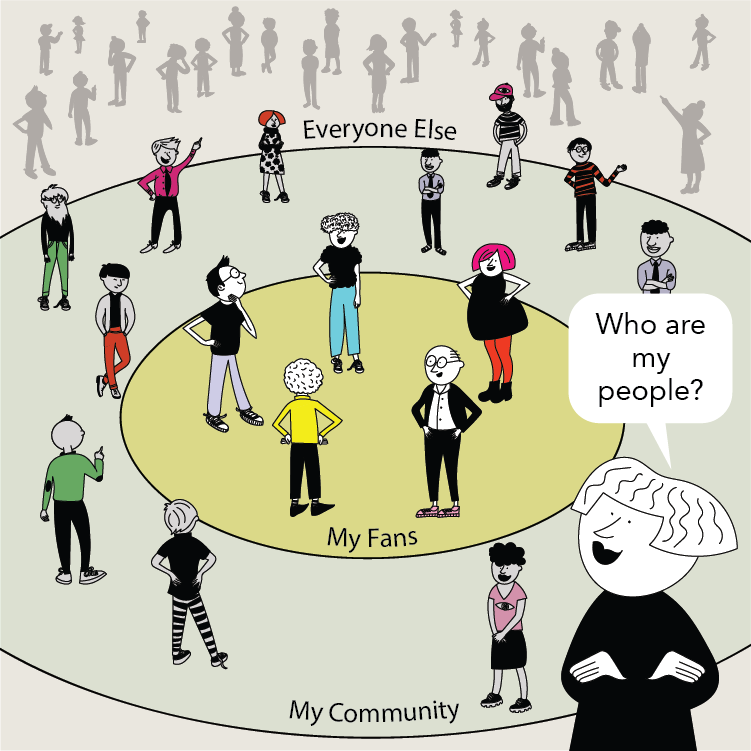
To make such a map, I start by asking - who are the people who help you achieve your goals? Who are your best clients? Nine out of ten clients stare at me blankly. And I understand why. Most of us skip the question entirely. We go straight to doing - a new platform, a post, a campaign that takes weeks to build. We invest time, money, and hope, and watch it land quietly in the void. We were never clear on who we were talking to. We just kept moving.
Once we gain clarity on who our people are, a second question follows: how many can we actually know well enough to tend?
This is where something shifts. Your core - the people who already believe in what you do, who come back, who refer others, who will tell you honestly when something isn't working - is smaller than you think. And that is not a limitation. It is a gift. A small, well-tended group of people who genuinely believe in you will do more for your business than a thousand followers who scroll past. The number will be different for every business. What matters is whether you know who they are, and whether you have real, sustainable ways of staying connected.
Robin Dunbar, an anthropologist at Oxford, found that humans have a cognitive limit of roughly 150 stable relationships - now known as Dunbar's Number. Beyond that, we lose the ability to really know people. The Romans understood something similar: their basic military unit was eight soldiers - the contubernium - who shared a tent, ate together, and fought together. Trust scaled through that small unit, not through mass coordination.
Around your core, a wider community - people connected to you but not yet as close. Beyond that: the public. These three circles are not a hierarchy of importance. They are a map of where your energy goes. If you look after your core well, they hold the golden key of how to reach your wider community. And your wider community, over time, reaches the public. That is not a shortcut. It is how communities have always worked.
The question to ask yourself is not: how do I reach more people? It is: do I know who my people are, and am I actually tending that relationship?
In practice, this changes what marketing looks like entirely.
Instead of producing content for the algorithm, you design experiences - events, conversations, writing, small gatherings - that feed the ecosystem around your work. You are not trying to fill an ocean. You are tending a garden.
And you choose the channels and activities that give you energy rather than drain it. If you love writing, write. If you come alive in a room with people, create the room. The right marketing is not the one that works in theory. It is the one you can actually sustain.
You do not need to talk to everyone. You need to talk to the right people. You probably already know some of them. Go and talk with them - that is a good starting point.
What excites me most right now is more of this - mapping ecosystems with clients and watching unexpected doors open, gathering where solutions emerge from the group, experimenting together rather than each of us figuring it out alone. A place to belong, as much as a place to work.
If you want help finding your people and building a marketing approach that actually fits your business, I would love to talk.
Cover photo by NON