Keeping Your Focus in a Noisy World
During the last 12 years, I have been building a business supporting multinational, government, public, and private organisations to communicate and engage their stakeholders effectively. I also spent over 30 years designing learning processes. During those years, I often find myself pulling out a blank page and drawing a simple diagram, as when my clients see their thinking process, penny-dropping moments come with ease. This is where the idea for a series of business articles came from. Over six issues, starting in March to coincide with Enterprise Week, I will introduce one visual model every month, sharing real-life examples, and offering practical questions that can be applied immediately. I encourage you to print the linked document or copy the simple model onto a blank page, and return to it when needed.
The Hedgehog Concept – updated
Many local business owners have shared how they feel swamped by competing businesses and family needs. With rapid external influences such as AI, technological advancements, global instability, and communication overload, staying clear and focused is a daily challenge.
The Hedgehog Concept is Jim Collins’s model from his 2001 book ‘From Good to Great’. The hedgehog refers to the Ancient Greek poet Archilochus, who wrote: “a fox knows many things, but a hedgehog knows one big thing”. Collins advises that businesses that want to survive must move away from being conspiring foxes who pursue many directions to be a razor-sharp hedgehog, finding their market niche, bringing together passion, skills, and economic power.
However, the world of business has changed significantly in the past 25 years; in today’s reality, many businesses must juggle a few ventures to survive. The model is still beneficial if we hold complexity and focus as the yin and yang of business and life. It can help us find a dynamic focus, a compass that brings clarity and helps us make strategic decisions.
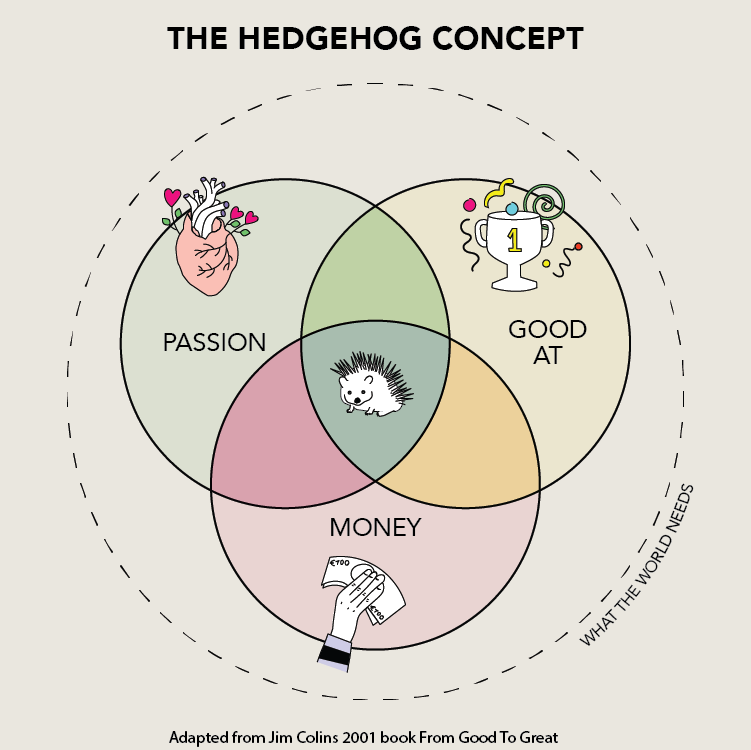
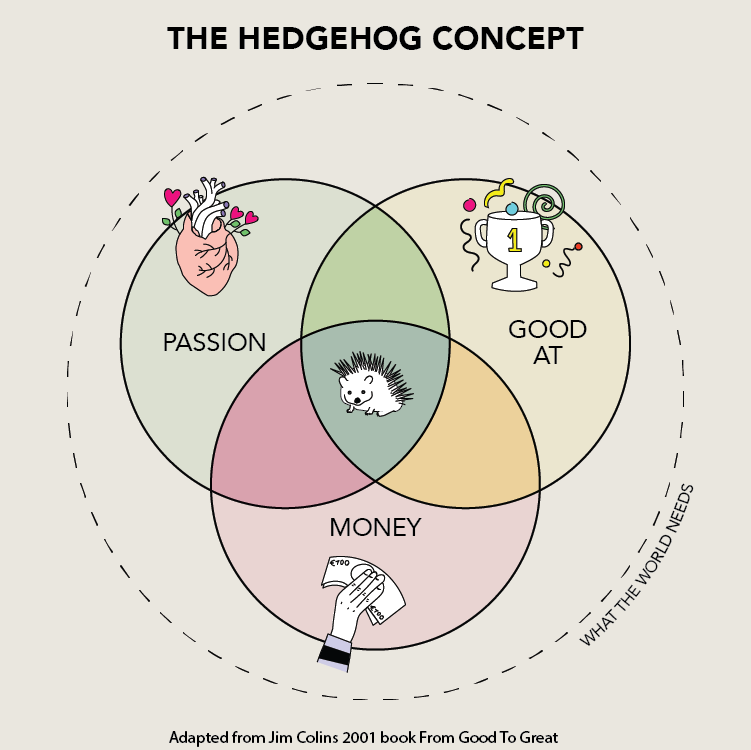
The model is a Venn diagram with three circles: 1) Passion; 2) What we’re good at; and 3) What generates money. The overlapping centre - the hedgehog- represents our life and business compass.
In each circle, we ask the following key questions:
Passion: What work energises us, even when it’s demanding? Which projects make us proud? What would we choose to keep doing, even if no one paid us?
What we’re good at: Which skills or talents come to us naturally and with ease? What do we get praised for? What do we do better than others?
What generates money: Which clients share our values, respect our work and pay us well? Which of our services are the most profitable? And which have potential to generate high income?
The following are two examples that illustrate how this model can be used:
Example 1 – applying the model with your team
A few years ago, at our annual ‘Rethink Think Visual’ offsite, we drew the three circles on a large whiteboard. First, focusing on Passion and Good At, we pulled out clients testimonials, shared stories, and mapped our individual and collective perspectives. Second, we added the Money generated from each client to the diagram.
The clients' names spread over the diagram. The process revealed the clients who sat in the centre – Clients that were aligned to our values, who paid well for work we loved and were excellent at. Those clients became our compass.
The clarity didn’t lead to dramatic change overnight. It showed up in small decisions: which projects we declined, how we rewrote our website messaging, and where we focused our energy. Over time, those small shifts strengthened both our confidence and our income.
Example 2: Making your personal story make sense
I’ve recently used this model with a client who, like many creative entrepreneurs, found herself juggling not one but four ventures. Instead of asking what to drop, we used the model to reframe her story, asking similar questions adjusted to an early business stage.
Passion: What are you truly passionate about? What can’t and won’t you stop doing?
Good At: Where have mentors, friends, or clients named your brilliance? What feels effortless to you but difficult to others?
Money: Which work generates money? Which doesn’t? Which clients value and respect your work? Which part of your work has higher potential to make money?
The outcome wasn’t a drastic cut. It was a clear sentence – a way of describing her core direction. It helped her shift her story from a woman standing at foggy crossroads into a heroine carrying her many gifts in her rucksack, her north star guiding her forward.
Adding a fourth circle
Inspired by the Japanese concept of Ikigai, you can choose to expand the reflection and include a fourth circle: 4) What the world needs.
This fourth circle allows us to connect to the bigger picture, asking questions like: What change do you care about? What values guide your work? What do you believe is needed right now?
Applying the Hedgehog Concept to your business
Download the printable version or draw three (or four as shown) overlapping circles on a sheet of paper. Use the questions above. Write freely. Add client names, offers, and projects. Notice patterns and tensions.
Use this model to navigate your life and business toward the centre of the circles, but remember the goal is not about getting there. It’s a dynamic map. Passion shifts. Markets change. Life evolves. The model is not a destination; it’s a compass. Reaching the centre can take years.
If you feel overwhelmed, unsure where to focus, or unclear about how to communicate what you really offer, this exercise can help you reconnect to your core.